

On 25 October, Tommaso Barbieri, Project Engineer from Aakhon, presented the “Advanced modelling of natural light” at the Trostburg Castle in Barbiano on the occasion of the 1st Active House School held from 22 to 29 October.
During this day dedicated to the study of natural lighting, Tommaso addressed the issue of Climate Based Daylight Modeling (CBDM) using Grasshopper, DIVA and Radiance as main software. This type of analysis allows to obtain more precise results regarding the quality of natural light in the rooms; in addition, it is possible to perceive the behaviour of the building throughout the year.
This type of analysis is particularly widespread in the United States and England and is mainly used in the LEED and BREEAM fields. In Italy, natural lighting tests are still simple ratio of paved/windowed area of 1/8.
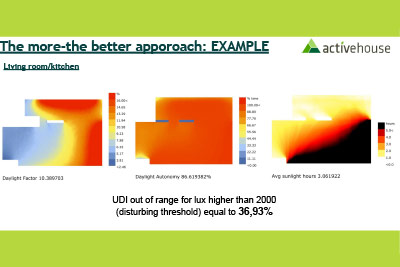 For proper lighting design, which leads to more liveable environments and contributes to the general comfort of an apartment, an e-Home building goes through 5 different dynamic simulations to ensure maximum visual comfort without affecting the energy performance of the building.
In fact, in the last period, especially in modern buildings, what is called “The more-the better approach”has been followed. This philosophy leads us to think that in order to have rooms with a lot of sunlight it is necessary to have a very large quantity of windows.
This leads not only to visual discomfort, as having too much light is just as annoying as having to make up for both the energy loads and the light overexposure resulting from this choice. The study of quantities such as Daylight Autonomy Useful Daylight Illuminance, Direct Sun Exposure and an in-depth study on glare that leads to the choice of the best blinds for each situation and orientation is the basis of an e-Home building as much as is the Energetic part. Because a well-lit house not only increases its value and is easier to sell but also improves the well-being and quality of life of those who live there.

